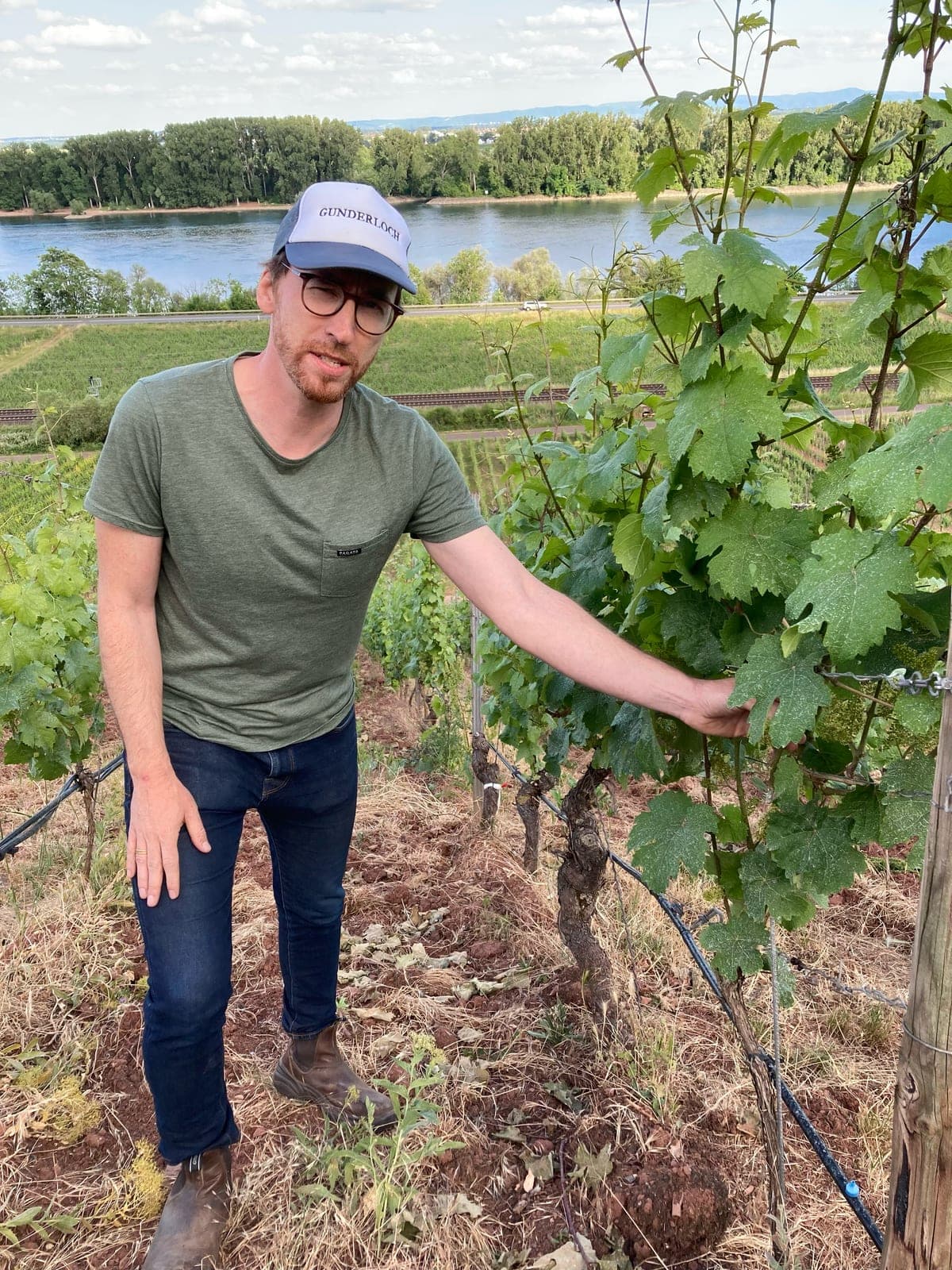
Brought to you by Blundstone, unofficial boot of wine people everywhere.
Gunderloch sits in Nackenheim, a village on the west bank of the Rhine just south of Mainz, at the northern end of the Roter Hang. The "red slope" is a five-kilometer stretch of steep riverbank between Nackenheim and Nierstein where the ground turns a rusty red. The soil is Rotliegend, a crumbly red slate and clay shot through with iron oxide, laid down some 280 million years ago. It holds heat, drains fast, and gives the Rieslings grown on it a spicy, savory character that people who know German wine can pick out blind.
The estate was founded in 1890 by Carl Gunderloch, a banker from Mainz who bought the Nackenheimer Rothenberg and set about proving that the Rhine front could make wine as serious as anything on the Mosel. He was a founding member of the VDP, the association of Germany's top estates, and Gunderloch is one of only four members that have never left. The family name got an unexpected boost in 1925 when Carl Zuckmayer, a playwright from nearby Nackenheim, wrote a hit comedy called The Merry Vineyard with a winegrower named Gunderloch at its center. The real Gunderlochs were not amused.
The modern estate is the work of Fritz and Agnes Hasselbach. Agnes is Carl's great-great-granddaughter; Fritz was a Geisenheim-trained winemaker who married into the family. They took over from her parents in 1986 with the goal of returning Gunderloch to the first rank of German producers, a position it had held before the wars. They got there. Their sweet wines from the Rothenberg earned a string of perfect scores in the 1990s, and Fritz became one of the Rhine's great evangelists for the red soil, famous for lighting up when he got to explain what the Rotliegend does to a wine. He died in October 2016 at seventy.
By then his son Johannes had already been making the wines for several vintages. Johannes studied business before coming back to the estate, and spent a year traveling and working with winemakers in the New World, an experience that shaped how he thinks about the cellar. Since taking over in 2016 he has pushed Gunderloch in a quieter, more vineyard-first direction. Farming is organic, with certification underway. Yields in the Rothenberg run around 45 hectoliters per hectare, among the lowest in Germany. The cellar, which under Fritz was strictly reductive and protective, now uses older barrels, longer time on the lees, spontaneous fermentation with native yeasts, and a few days of skin contact on the top wines. The dry wines have gotten drier, lower in alcohol, and more mineral. The wines are never de-acidified; in a high-acid year, he just waits longer to bottle.
Gunderloch owns about two-thirds of the Rothenberg, all of it planted to Riesling, with the rest of the estate in the steep Nierstein sites of Pettenthal and Hipping five kilometers down the river. Johannes has also led the Rheinhessen chapter of the VDP since 2019, and is one of the younger members pushing the organization toward chemical-free farming.
Each generation, he says, ends up defining its own relationship to the Rothenberg. His is still being written, but the direction is clear: less in the cellar, more on the slope, and a Riesling that tastes like red dirt above a big river.