Ballard Canyon sits in the middle of the Santa Ynez Valley, between the cold of the Sta. Rita Hills and the heat of Happy Canyon — a north–south run of rolling hills climbing to about 1,200 feet, close enough to the coast that the Pacific cools the vines at night and holds the acidity in. JONATA calls itself a goldilocks estate on that account: not too hot, not too cool. During ripening, the swing between afternoon and night can reach forty degrees.
The ground is what matters here. Deep concentrations of Careaga sand run through the estate — as JONATA puts it, as though the beach had been dropped into the foothills. The sand is poor in nutrients but holds water better than you would expect, and its depth and shape send roots far down in search of everything else. That is where the estate's trademark tannin comes from: not weight, but reach. The name is a debt to the people who were here first. Jonata is Chumash for tall oak; the land was part of the 1845 Mexican land grant of Rancho San Carlos de Jonata, and the estate sits at the heart of the original grant.
Matt Dees arrived in 2004, hired at twenty-five as the estate's first winemaker. He was not an enologist — he had studied at the University of Vermont, helped plant a vineyard there as a student, and worked harvests at Staglin in Napa and Craggy Range in Hawke's Bay. He came to the property with a grounding in soil and farming rather than cellar technique, and that order has shaped the estate ever since. Twenty-two vintages later he is still on it, alongside vineyard manager Ruben Solorzano and associate winemaker Drew Pickering. In California, that kind of continuity is the rarer credential.
What surrounds the vines matters as much as the vines. JONATA farms on the polyface model — a working ranch rather than a wine facility. Chickens, turkeys, sheep, goats, and pigs are integrated for soil health, fire protection, and compost. There are orchards, olive trees, native oak, cover crops, and gardens that feed the crew's families. Coyotes, boars, and mountain lions come through. Every one of those is doing a job that a bag or a spray would otherwise be doing, and the wine is downstream of all of it.
Fifteen varieties are planted here. Among the reds: Syrah, Cabernet Sauvignon, Merlot, Cabernet Franc, Petit Verdot, Petite Sirah, and Sangiovese. Among the whites: Sauvignon Blanc, Sémillon, and Viognier. Bordeaux and Rhône side by side on roughly eighty-four planted acres, with no Pinot Noir and no Chardonnay. That is what The Hilt is for.
Each wine shows a different side of the same place. La Sangre — the blood — is Syrah with Viognier, savory and seismic, and the closest thing the estate has to a self-portrait. El Desafío — the defiance — is Cabernet Sauvignon, chiseled and unrelenting. Fenix is a Merlot-dominant Bordeaux blend — in most years labeled as varietal Merlot — dense and impenetrable, a phoenix because the variety came back to the lineup after being written off. Flor is the Sauvignon Blanc, off the block pictured above. And Todos — everyone — is the whole estate in a bottle, red and white varieties together, which the winery describes with unusual honesty as forty percent Rhône, forty percent Bordeaux, and twenty percent chaos.
It would be easy to file JONATA under trophy purchase. The estate belongs to Stan Kroenke, the American billionaire whose holdings include the Los Angeles Rams, Arsenal Football Club, and Screaming Eagle in Napa Valley, and it has never wanted for capital. The more interesting question is what the money actually bought: the freedom to farm a difficult site on the site's terms, to plant fifteen varieties where most estates plant two, to run livestock through it, and to keep one team on one piece of ground for two decades. Patience is the expensive part. The rest is farming.
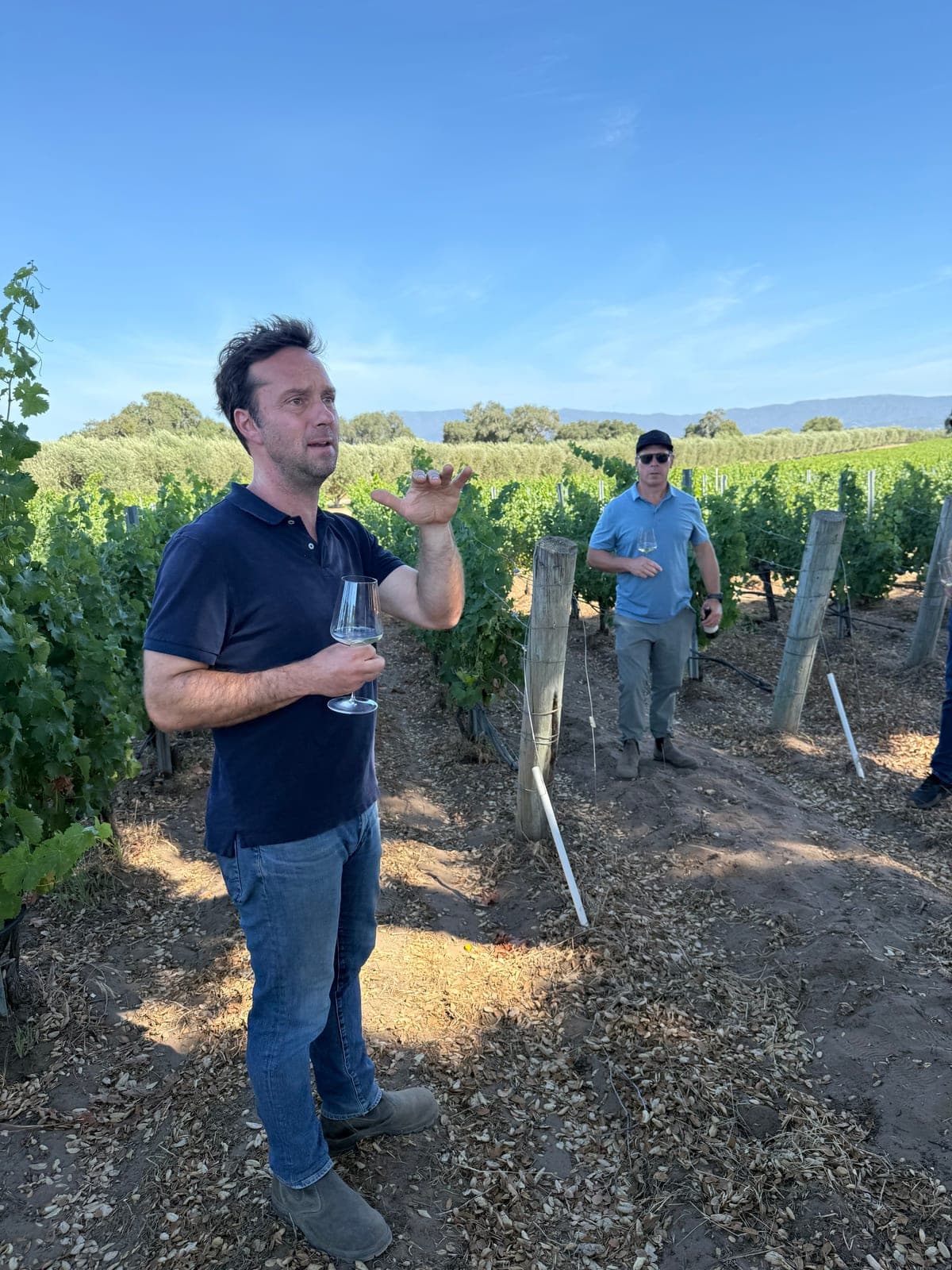
Twenty-two vintages in, Dees still walks the rows with a glass in his hand, explaining what the sand did that year. The estate has never rested on one person — the crew, the livestock, the orchards, and the oaks all do their share. But it has depended on someone staying long enough to notice what changes.