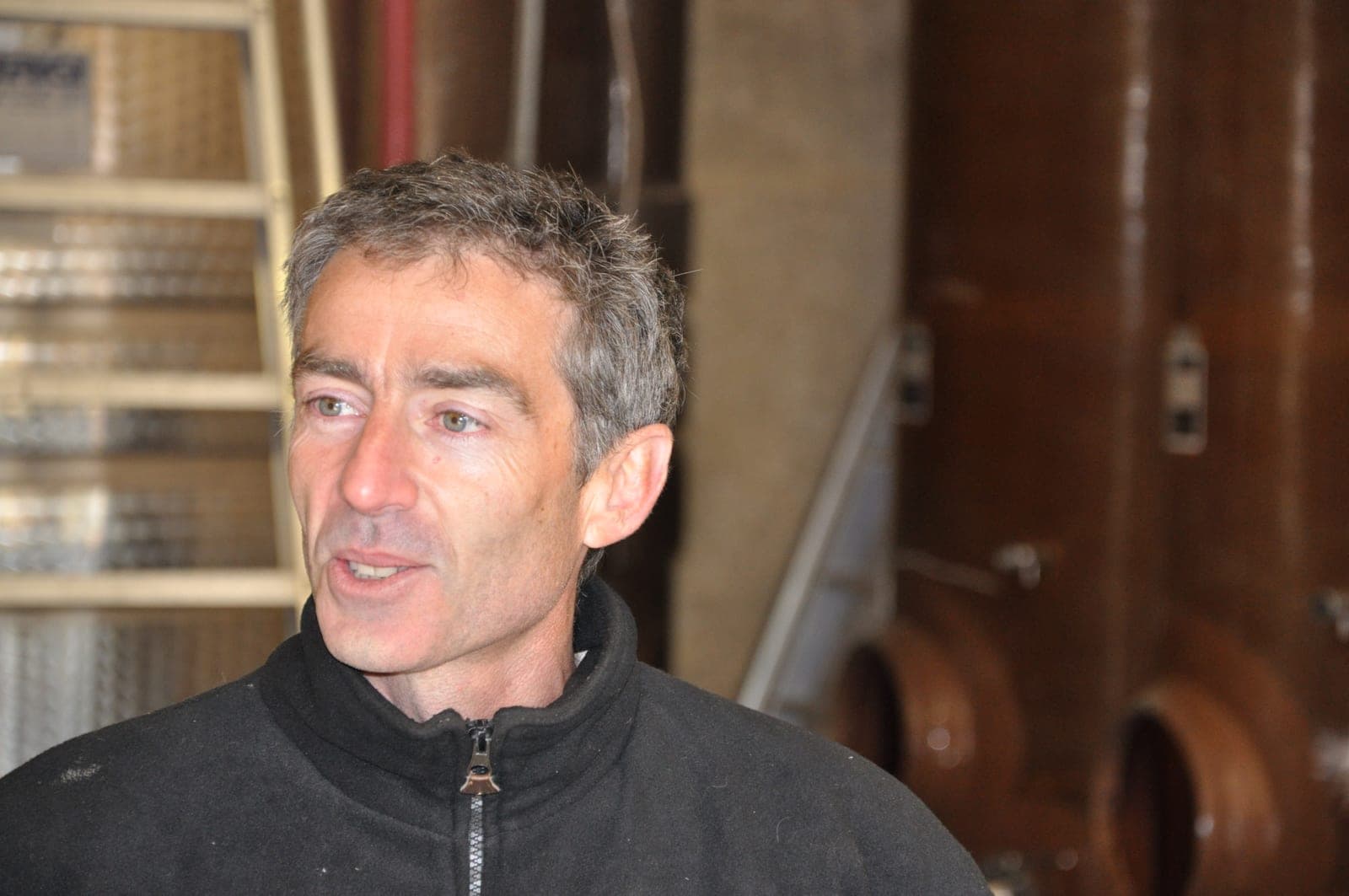
Jonquières sits at the foot of Mont Baudille, about forty kilometers inland from the Mediterranean, where the limestone terraces under the Larzac plateau begin to climb. The Julliens have farmed there for generations, around Jonquières and neighboring Saint-Félix-de-Lodez, and for most of the last century that meant one arrangement: the grapes went to the cooperative, and what became of them afterward was someone else's business.
Olivier's father, Jean-Pierre, did what nearly everyone did. In 1970, with the Languedoc emptying out and its vineyards worth less every year, he gave his land a name — Cal Demoura, Occitan for "one must remain" — and then closed his own cellar and joined the co-op. Those two facts sit uneasily together: a declaration of staying, and a decision to stop making wine.
Olivier refused the same arrangement. He finished his viticulture and oenology studies in 1985 and, at twenty, converted outbuildings on the family farm into a cellar and began bottling under the Mas Jullien label. He did not simply take over his father's vines; he went out and bought his own parcels instead.
He has been plain about why, and it was not ambition. Talking to Andrew Jefford, he traced the decision back two generations, to a grandfather and a father he described as "humiliated by the world of wine" — the co-op arithmetic, the bulk market, the assumption that nothing serious could come out of the south. He called his own motive revolt, and said he never felt he had a choice in it. Years later he put it differently: what really drove him, he decided, was love for the Languedoc rather than anger at what had been done to it.
Then came the part of the story that gets it remembered. In 1993 Jean-Pierre resigned from the cooperative, sold off his weaker land, kept about five hectares of the best, and started making wine under the name he had chosen twenty-three years earlier. Mas Cal Demoura became one of the wines that led the region's turn toward quality, and when Jean-Pierre retired in 2004 he sold it to Isabelle and Vincent Goumard, who spent a year working alongside him first, with Olivier helping the new owners find their footing. The usual direction of a wine family is a father handing something down. Here the son went first and the father followed him out. Olivier has described that break as a courageous and highly symbolic act, and said that in making it his father "quite simply became himself." Twenty-three years of sending fruit to the co-op, and a name on the gate the whole time that said one must remain.
Mas Jullien has gotten smaller on purpose since. Olivier has sold parcels he judged disappointing and bought better ones, dropped Grenache he couldn't keep below fifteen percent alcohol, and pulled back on Syrah until Carignan and Mourvèdre carried the reds. He has also taken vineyard out of production altogether, replanting scrub to put some balance back into the land around the vines. The whites — Carignan Blanc with Chenin, Roussanne, Clairette and Grenache Blanc in varying proportion — are among the few in the Languedoc that taste tense rather than broad. Twenty years ago he named Syrah and Carignan as the pairing he loved; that pairing has since given way to the one he works with now, which is about right for a grower who has changed nearly everything in order to keep doing the same thing.
Two details say the rest. He once hired a man for a full year to rebuild dry-stone walls, and what mattered to him was less the walls than the old growers seeing that work valued again after thirty years of being told it was worthless. And a line from Gibran's The Prophet is tacked to the office wall, about work being love made visible. He talks about a star overhead and a wire running from your hands toward it, all work being a reach along that wire. It is the kind of thing that would sound unbearable from most people and sounds entirely ordinary from him.